Click the "view show" tab, if the slideshow doesn't open automatically
As promised last week, this is the first in a series of blogs which will be posted each Wednesday on the topic of memorials and public sculptures. No don’t log off, read on, I’ll try to make it interesting, if not entertaining.
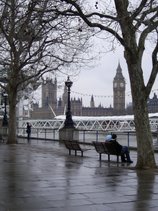
The Victoria Embankment Gardens located between Hungerford and Waterloo bridges is an oasis from the hustle and bustle of daily city life, for tourists and Londoners alike. You can sit on a bench and leave the noise of the traffic drift into the background. You are however jarred back to the present moment every 3 to 4 minutes by the incongruous sound of a passing underground train. Look shrubbery is a wall. Enclosed by the wall is a ventilation shaft for the section of the District and Circle Underground Line running between Embankment and Temple stations. around but no train is to be seen. But look carefully, hidden by the
There is a drinking fountain on the north side of the enclosure. No longer in use, nevertheless it is an object of interest. On the bronze plaque forming part of the fountain are the words “Erected To The Memory Of Henry Fawcett By His Grateful Countrywomen”. Who was Henry Fawcett, what had he done to warrant a memorial to be erected by his countrywomen?
Look closely at the relief and you see the figures eyes are closed, as if in sleep. Henry Fawcett was born in Salisbury, England in 1833. Aged 25, while out shooting he was accidentally blinded by a shot from his father’s gun. Despite the handicap, he continued his studies at Cambridge University. Five years later he became Professor of Political Economy in Cambridge.
Two years later, in 1865 he became a Member of Parliament representing the south coast resort town, Brighton. Once in Parliament he attempted, with John Stuart Mill and Peter Alfred Taylor, to persuade Parliament to change the law to grant women the vote. Through his campaign for women’s suffrage he met Millicent Garret. Although she was 14 years his junior they married in 1867. Together they were active members of the National Union of Women’s Suffrage (NUWSS).

In 1880 Henry became a member of the Government led by William Gladstone. As Post Master General, the Minister responsible for the postal service, he introduced the first parcel post service, postal orders and the telegram.
In 1882 he was taken seriously ill with diphtheria. Although he survived, he was seriously weakened. Aged just 51 he died of pleurisy in 1884.
In 1890 Millicent was elected president of the NUWSS and continued to be a leader of the suffrage movement. She died aged 82 in 1929; one year after all women, aged 21years and over, finally gained the vote in Great Britain.
So that is why his fellow countrywomen erected a drinking fountain in the memory of Henry Fawcett.
Click here and visit YesBut's Images site and join in the fun.

 Every Wednesday for the last couple of months, I have posted blogs on memorials and public art works. These are normally prestigious works of art located in prominent locations. Today’s memorial is very different, and is probably the most moving.


 The cardboard city was removed in 1997 to allow an IMAX cinema to be constructed in the centre of the roundabout. The homeless were dispersed, some to hostels, others to find new nooks and crannies to sleep in.